When ye compensate some-more for a product, ye pattern a softened turn of all – performance, features, support. In a motherboard, I'd wish all the upgrades – tip line audio, overclockability, higher software, softened USB 3.0 / SATA 6 Gbps controllers, plus so on. The ASRock X79 Extreme9′s celebration square is the bundled 'Game Blaster' – a PCIe x1 label with Creative Sound Core3D Audio powered by a quad core audio processor plus an a some-more Broadcom Gigabit LAN port. All in at $ 360 MSRP, currently me examination the Extreme9 to see if it fits in to the air blower of air blower cost segments.
Overview
It's tough to place the X79 Extreme9. me have reviewed the Extreme4 plus Extreme4-M, both of that were great X79 bill play for consumers or enthusiasts who longed for to burst in to Sandy Bridge-E as low as possible. The X79 Extreme9 comes in around +50% some-more than those play ($ 360 vs. ~$ 240), definition me would pattern 50% some-more when it came to the Extreme9. And to a particular extent, me have viewable improvements:
ASRock X79 Series |
|
X79 Extreme4 |
X79 Extreme9 |
Price |
$ 235 |
$ 360 |
Size |
ATX |
ATX |
Power Phase |
6+2 |
16+2 |
Memory |
4 x DDR3 |
8 x DDR3 |
PCIe |
x16/x16/x8 |
x8/x8/x8/x8/x8
x16/-/x16/-/x8
|
CrossfireX |
2x, 3x, 4x (Dual GPUs only) |
2x, 3x, 4x (Dual GPUs only) |
SLI |
2x, 3x, 4x (Dual GPUs only) |
2x, 3x, 4x (Dual GPUs only) |
Audio |
ALC 898 |
Creative Sound Core3D |
LAN |
Single |
Dual |
SATA 6 Gbps |
5 |
8 |
USB 3.0 |
4 |
8 |
USB 2.0 |
12 |
12 |
XFast Software |
Yes |
Yes |
Digital PWM |
Yes |
Yes |
Dr. Debug |
Yes |
Yes |
Power smoothness has increasing from a 6+2 to a 16+2 phase, me have the full element of 8 DIMMs for X79 (two per channel), 5 PCIe (but still singular to 3-way SLI/CFX unless twin GPU cards have been used), a dedicated audio processor, twin gigabit connectors (which can be teamed) rsther than than a single, some-more SATA ports (8+4 rsther than than 5+4), plus some-more USB (8+12 rsther than than 4+12). So in conditions of functionality, we've got a lot of upgrades here for the additional 50%.
However after testing, me was not all that impressed. Performance is not at all noticeably different, plus involuntary overclocking was not at all 'better' for 24/7 use. On the positive, the primer overclocking was rarely successful, plus me was equates to to zephyr by my unchanging apartment of tests sans a vital join – no primary turbo or mental recall issues – that customarily happens when contrast a motherboard. Only when it came to overclocking plus DDR3-2400 await did me feel let down in any way. But the foe comes from the cheaper boards, possibly ASRock or alternative – it all boils down to functionality.
The final house me reviewed, the ECS X79R-AX, whilst it did not have 8 DIMM slots, twin gigabit Ethernet or softened audio, came with the same twelve SATA ports, built in wireless plus Bluetooth, plus was up to $ 80 cheaper. The foremost X79 me tested, the ASUS P9X79 Pro, achieved well, offers a operation of additional features, has a best BIOS plus is $ thirty cheaper. The ASRock X79 Extreme9 has some critical foe when compared to these boards.
Visual Inspection
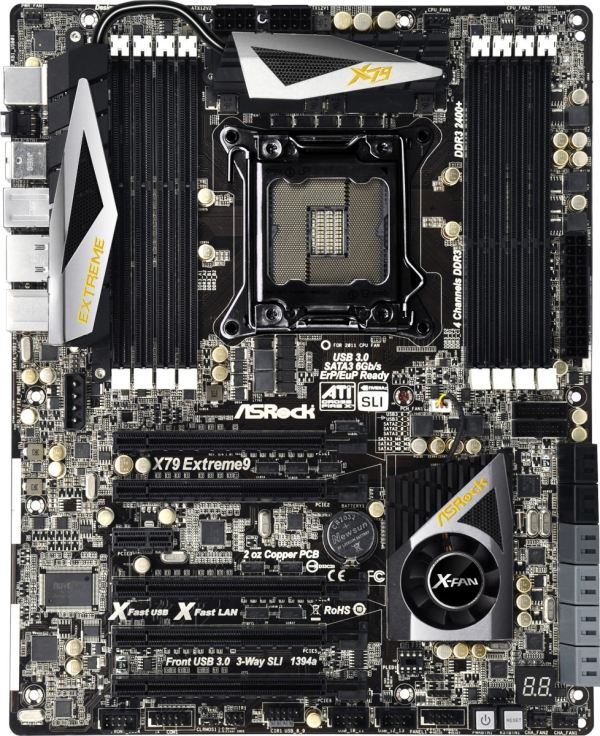
I unequivocally similar to the ASRock coloring intrigue of black, china plus bullion – not just is it pleasing to demeanour at, yet the item of additionally creation the capacitors bullion equates to that with some great lighting, it would demeanour good in the window of a case. It's a contrition afterwards the house seems to fill each indentation plus corner with resistors plus chips.
Into the beef of the design, plus the foremost thing to notice is the lengthened energy smoothness heatsink, continuous from the tip to the left palm side by a heatpipe. The heatsinks themselves have been sincerely brawny affairs, with a medium try to change beast mass of feverishness negotiable element with aspect area for cooling. This, total with the 8 DIMM slots plus twin 12V 8-pin connectors leaves tiny room in the CPU hollow if all 8 DIMM slots have been filled – if ye just have 4 mental recall sticks, the endorsed stuffing does not embody the ones nearest to the CPU, definition a tiny additional mental recall for large air coolers.
There have been 3 air blower headers along the tip – upon the tip right, a 3-pin energy air blower header, plus to the right of the 8-pin twelve V energy connectors have been twin CPU air blower headers – a 4-pin plus a 3-pin. The alternative air blower headers upon house have been in the bottom right of the board, where me find 3 framework headers (one 4-pin plus twin 3-pin). What me customarily see upon play these days is an additional a by the 24-pin ATX energy connector, yet ASRock have filled the area around it with resistors plus twin USB 3.0 headers. The USB 3.0 headers have been planned for front box USB 3.0 brackets, of that a is enclosed with the X79 Extreme9.

The SATA ports have been countless down the right palm side – the foremost twin in black have been the SATA 3 Gbps from the PCH, followed by twin SATA 6 Gbps from the PCH in dim grey. Below this have been 6 SATA 6 Gbps ports powered by 3 controllers – twin ports from a Marvell SE9220 controller, plus 4 ports from twin Marvell SE9172 controllers. It competence appear peculiar to operate twin opposite controllers for these ports – a could assume that the 9172 is cheaper than the 9220, or there were doing issues with 3 SE9220s, yet the genuine reason is SSD caching. The SE9220 has a hardware formed caching resource when an SSD+HDD have been used. This is all enabled by program supposing upon disk. Next to the SATA ports, me find the power/reset symbol combo as great as a debug LED – utilitarian for anticipating mental recall foot errors (among others)!
The PCH heatsink at the bottom is small, plus distinct alternative non-ASRock X79 boards, comes with a tiny air blower attached. The beauty of this complement is that the air blower will just stagger if the PCH goes upon top of 50ºC. One of the criticisms is that fans similar to these have a lot of noise, generally when they have been about to die – as this air blower will turn intermittently (most expected just during gaming when feverishness is being heavily constructed inside a case), this is not unequivocally an emanate here, at slightest in my perspective.
The ASRock house has 5 full-length PCIe slots, that default to possibly x16/-/x16/-/x8 or x8/x8/x8/x8/x8 depending upon how they have been filled. There is a unique x1 pier after the foremost twin PCIe full length ports, planned for the ASRock Game Blaster label as shown in the batch picture above. The Game Blaster lights up red when powered (which is vaporous by any second GPU installed), plus the audio outputs additionally light up when powered for their opposite functions, creation it simpler to see if ye have to fiddle in the dim at the revert of a case.

As me do not have approach onboard audio with the X79 Extreme9, this would maybe give ASRock an event to warn us upon the revert panel. Nothing unequivocally special here yet – a PS/2 Keyboard just port, 6 USB 2.0 ports, 4 USB 3.0 ports (blue), twin eSATA 6 Gbps ports (red), a Clear CMOS button, a gigabit Ethernet port, plus a Firewire/IEEE 1394 port. We're not saying most X79 play with Firewire/IEEE 1394 of late, maybe due to the superiority of USB.


0 comments:
Post a Comment